


Adam Pankratz: Reconciliation law will be David Eby's downfall
There's no way B.C.'s premier can survive after backing down on his promise to amend the economically ruinous piece of legislation

Though no one in British Columbia’s current NDP government will say it, it’s clear that David Eby’s days as premier are numbered. He has backed himself into a corner from which there can be no escape, despite his preference to protect his own political skin at the expense of the prosperity of British Columbians.

The issue that will sink Eby is, ironically, something that the premier himself was a major cheerleader for: B.C.’s Declaration on the Rights of Indigenous Peoples Act (DRIPA). The act’s aim was to ensure that new B.C. laws were in alignment with the United Nations declaration on the same topic, often referred to as UNDRIP.

tap here to see other videos from our team.
Adam Pankratz: Reconciliation law will be David Eby's downfall Back to video
tap here to see other videos from our team.
I have written at length about the incompatibility of the UN declaration and Canadian law in this paper, but a recap of the main issues that will take Eby down are worth highlighting to demonstrate the extent of the calamity facing B.C. as a result of actions that Eby is finally being held accountable for.

Article 26 of UNDRIP states that, “Indigenous peoples have the right to own, use, develop and control the lands, territories and resources that they possess by reason of traditional ownership or other traditional occupation or use.”
That is to say, if an Indigenous group claims a territory, under a literal reading of UNDRIP, the group would appear to own the land and all its resources. In theory, that means the 95 per cent of B.C.’s land base that is Crown land is no longer controlled by the government, but by the First Nations that claim ownership of it.
Further, Article 32(2) states that, “States shall consult and co-operate in good faith with the Indigenous peoples concerned through their own representative institutions in order to obtain their free and informed consent
prior to the approval of any project affecting their lands or territories and other resources, particularly in connection with the development, utilization or exploitation of mineral, water or other resources.”
This “free and informed consent” requirement goes much further than the Supreme Court’s “duty to consult” doctrine under Section 35 of the Charter and treads dangerously close to being an effective veto over many government decisions.


UNDRIP is ultimately an aspirational human rights document that was never intended to be law, yet this is what it has become in B.C. since December 2025, when the B.C. Court of Appeal ruled that under DRIPA, the principles of UNDRIP must be applied to all provincial laws. The results have been extraordinarily destructive, both economically for the province, and politically for Eby.
As a result of DRIPA, no one in B.C. has any certainty anymore as to who is in charge of the province and, in particular, its land. It is even a question as to whether the government can make its own laws anymore without First Nations’ free, prior and informed consent.
This may sound hyperbolic, but it is not, as Article 19 of UNDRIP states that Indigenous peoples must give “free, prior and informed consent” over “legislative measures.” This raises the question of whether DRIPA, or indeed any B.C. law, can be amended without First Nations’ consent.
- Advertisement 2Story continues below
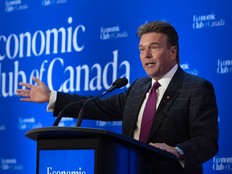




As a result of DRIPA, nothing can get done in B.C. and the economy is in a tailspin, resulting in the province’s credit being downgraded and its population declining by 41,000 people last year — the first decline in 150 years — as citizens flee for better economic opportunities.
Recognizing that he might have a problem on his hands, Eby said earlier this year that he would table legislation to amend or possibly suspend DRIPA for three years in order to sort out the whole mess. None of that will happen.
Indigenous groups said they would take legal action against the government if it makes any changes to DRIPA, and enough members of Eby’s own caucus told him they would vote against his amendments that the legislation wouldn’t pass. Faced with that reality, Eby’s resolve disintegrated faster than the Vancouver housing market he helped torpedo, and he pulled the bill.
David Eby and his NDP have tried to sell British Columbians on the idea that DRIPA is the path toward reconciliation. Instead, it has proved to be a path to chaos and economic despair, which Eby is finally wearing.
This week, he had the opportunity to show some belated courage and table legislation to amend or suspend legislation that is clearly hurting the province and its citizens, despite the political risk associated with doing so.
Faced with that choice, Eby chose to protect the only person in the province that he appears to have any regard for: himself. It will not be enough to save his premiership.
National Post
Adam Pankratz is a lecturer at the University of British Columbia’s Sauder School of Business and sits on the board of B.C.’s Public Land Use Society.
- Advertisement 3Story continues below





Postmedia is committed to maintaining a lively but civil forum for discussion. Please keep comments relevant and respectful. Comments may take up to an hour to appear on the site. You will receive an email if there is a reply to your comment, an update to a thread you follow or if a user you follow comments. Visit our Community Guidelines for more information.