


Carney lists West Coast pipeline as project of national interest, fast-tracks regulatory process
'Canada will remain a country of high standards, but high standards do not require slow decisions,' Carney said

OTTAWA – Prime Minister Mark Carney announced Thursday that his government has listed a proposed West Coast oil pipeline, now known as “Pacific Link,” as a project of national interest that will enter a fast-tracked regulatory process.

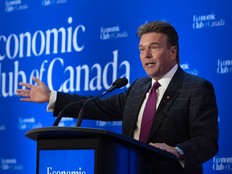
“Our government was elected to change things, to build Canada strong, and we’re doing just that,” said Carney, during a press conference in Fort McMurray, Alta.

tap here to see other videos from our team.
Carney lists West Coast pipeline as project of national interest, fast-tracks regulatory process Back to video
tap here to see other videos from our team.
“Canada will remain a country of high standards, but high standards do not require slow decisions,” he added.

The Government of Alberta submitted the proposed pipeline project to the Major Projects Office (MPO), to be considered in the national interest under the Building Canada Act. The proposed route will run 1,200 kilometres from Bruderheim, Alta., to a proposed large-tanker port in Roberts Bank, B.C.
Following Alberta’s submission on July 1, the MPO spent the last three months consulting with more than 130 Indigenous communities who are near the potential route, as well as the Government of British Columbia.
The MPO will begin its review of the project in early 2027, with public hearings held by the commission of the Canada Energy Regulator. The MPO is expected to finalize a conditions document by Sept. 1, 2027.
Government officials speaking on background said that as the regulatory process progresses, open season on the pipeline is expected in the spring of 2027, which is a period in which a pipeline operator seeks binding commitments from shippers for capacity on a proposed new pipeline.
Carney was asked if he has received any assurances from oil sands companies that they will invest in the expansion of their operations, in order to fill the pipeline.


The prime minister said that will ultimately be commercial decisions those companies will make, but that an opportunity exists to close the price differential between West Texas Intermediate, the crude benchmark for the U.S., and Western Canadian Select, Canada’s heavy crude oil benchmark.
“This is a tremendous commercial opportunity for them, given diversification of markets, given the prospect of narrowing the differential that exists,” said Carney. “That’s worth, I mean, you can do various calculations, but somewhere between six to $10 billion a year.”
The proposal is part of an agreement between the Alberta and the federal government, designed to ramp up oil exports while hiking other environmental initiatives, like the Pathways Project and a methane emissions framework.
Carney was joined by Alberta Premier Danielle Smith, who outlined how the agreement has helped her government secure abeyance of the federal clean electricity regulations, an impact assessment agreement to streamline project reviews, the suspension of the federal zero-emission vehicle mandate and assurances by the feds not to impose an oil and gas emissions cap.
- Advertisement 2Story continues below




“All of these milestones have brought us to this moment, and this is a monumental day for our province and for our country,” she said. “It is also an important step towards our goal of securing the necessary approvals and conditions for design and construction to begin as early as Sept. 1, 2027, turning this project from a vision into a reality.”
So far, the pipeline is financially backed by Alberta and the federal government, although financing details have still not been presented to the public.
Carney was asked specifically how many billions of tax dollars Canadians are expected to put towards the project.
“The Canadian taxpayer is going to make a lot of money off this pipeline,” replied Carney, without answering the question.
Calgary-based Pembina Pipeline has so far agreed to take a minority 10 per cent private stake in the development, the publicly owned Alberta Petroleum Marketing Commission is also a proponent. The Trans Mountain Corporation is leading the project.
However, government officials confirmed on Thursday that Pembina has not put forward any funding for the early stages of the regulatory process, such as technical assessments, engineering and safety assessments, nor the costs of consultation with Indigenous communities.
A government official said the early process is estimated to cost $4 billion, which will be provided by the Alberta and federal governments through Trans Mountain Corp. and the Alberta Petroleum Marketing Commission.
According to a background government document, Indigenous communities during the consultation process remain unsure of the success of the project, given the lack of route-specific, environmental and mitigation-related information.
Government officials speaking on background said the route will be determined in consultation with Indigenous communities.
Carney said the specifics of the project, such as cost estimates, procurement, workforce planning, and ecological assessments, will be determined in tandem with consultations.
“Projects like this spend potentially billions of dollars doing this work before even knowing whether the federal government stood on a project,” said Carney. “Now, we’re making our position clear at the beginning of the process rather than at the end.”
Indigenous communities can expect a “minimum” 10 per-cent stake in the Pacific Link pipeline project. It’s unclear how much higher that stake can be increased.
Government officials said the ownership stake is only part of the economic participation Indigenous communities can expect from the project, which will also include mutual benefit agreements. Officials used the Trans Mountain Expansion Project (TMX) as an example, which had 69 mutual benefit agreements worth well over 600 million dollars, as well as jobs for 3,600 Indigenous workers.
The Pacific Link Pipeline once completed, will allow Canada to export an additional one million barrels a day, including to markets in Asia.
The pipeline is expected to generate over $20 billion in GDP per year and $100 billion in government revenue by 2060. The government said the project will generate 140,000 jobs across the country. The total cost of financing the pipeline project is estimated between $35.2 billion and $43.7 billion. The aim is to have the pipeline operational by 2032-2033.
The proposed Pacific Link project could face other types of hurdles, beyond just regulations.
TMX, which came into operation in 2024, faced years of legal challenges by Indigenous communities, environmental groups and municipalities, including the City of Burnaby, where the end point for pipeline is located at the Westridge Marine Terminal.
The viability of the project was jeopardized, which forced the federal government under former prime minister Justin Trudeau to purchase the pipeline from Kinder Morgan for $4.7 billion in 2018. The ultimate cost of the TMX project was over $34 billion to build.
Government officials on Thursday acknowledged there probably will be court challenges to the Pacific Link project, but remained confident that issues can be addressed in the early stages of the regulatory process.
National Post
Our website is the place for the latest breaking news, exclusive scoops, longreads and provocative commentary. Please bookmark nationalpost.com and sign up for our daily newsletter, Posted, here.
- Advertisement 3Story continues below





Postmedia is committed to maintaining a lively but civil forum for discussion. Please keep comments relevant and respectful. Comments may take up to an hour to appear on the site. You will receive an email if there is a reply to your comment, an update to a thread you follow or if a user you follow comments. Visit our Community Guidelines for more information.