


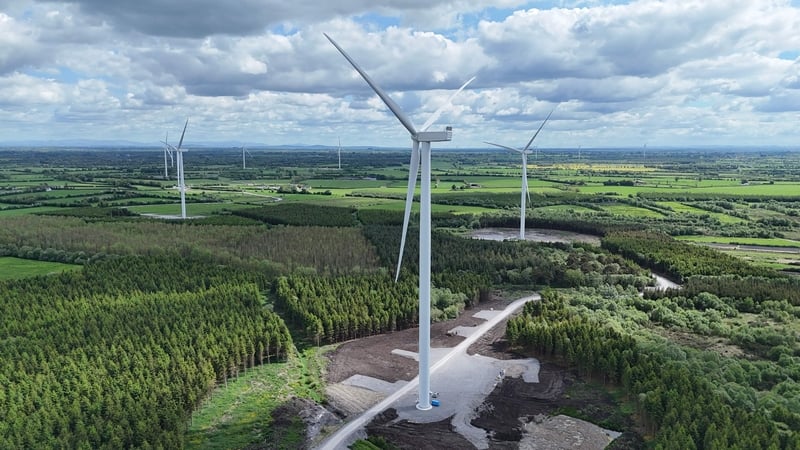
Enough wind energy to power 667,000 homes, or roughly every household in Dublin, Westmeath and Wicklow combined, was lost in the first half of 2026 as the grid struggled to keep pace with Ireland's renewable energy growth, Wind Energy Ireland has said.
New analysis from Wind Energy Ireland, based on EirGrid figures, shows that significant volumes of renewable electricity generated by Irish wind farms could not be used because the electricity grid was not strong enough to carry it.
Despite these grid challenges, Irish wind farms set a new record last month, with generation up nearly 5% compared to the previous record in June 2025, reversing months of rising wholesale prices.
Wind energy remains Ireland's largest source of clean electricity, providing more than a third of the country's power since the start of this year.
But the amount of wind energy lost every year highlights a growing gap between the growth of renewable energy and the infrastructure needed to move, store and use that power, according to Wind Energy Ireland.

Director of External Affairs at Wind Energy Ireland Justin Moran said: "In the first six months of this year, 15% of Ireland's most affordable electricity was wasted because our existing grid was simply not strong enough to carry all the power that our wind farms produced to Irish homes and businesses.
"Every unit of renewable electricity we lose is a missed opportunity to reduce our reliance on imported fossil fuels and lower electricity costs for Irish consumers and businesses.
"That's why we need to accelerate investment in the electricity grid, energy storage and other technologies that allow us to make full use of renewable power when it is available."
Work underway to increase renewable electricity capacity to 95% - EirGrid
In response, EirGrid said that it "has made significant progress in integrating renewable electricity, with the power system now able to safely operate with up to 75% of electricity coming from variable renewable sources such as wind and solar at any one time. Work is underway to increase this to 95%."
It said that what it called 'Renewable dispatch down' was "a challenge faced by power systems internationally, particularly as more variable renewable generation connects to the grid, as is the case in Ireland.
"In the first half of 2026, EirGrid enabled 86.8% of wind energy generated to be brought onto the power system in Ireland, with 13.2% dispatched down. Overall, EirGrid enabled 88.8% of renewables (including solar and wind) to be brought onto the system during this period, with 11.2% dispatched down."
EirGrid said that it was making progress bringing more renewable energy onto the system, with 1 GW (gigawatt, enough to power around 500,000 customers) of electricity provided by grid-scale solar power for the first time in April and a new record for wind generation of 3.89 GW in February.
It said that as more renewable electricity connects to the system, "some renewable generation may need to be turned down at certain times when available renewable generation cannot be fully accommodated due to surplus generation, system-wide security requirements, or local network constraints.
"To increase the capacity of the electricity grid and further increase the integration of renewable energy, EirGrid is undertaking the most ambitious programme of work ever undertaken on the transmission system. The Government and regulator have provided an investment package of €18.9 billion to EirGrid and ESB Networks over the next five years to deliver this infrastructure across the country."
Wholesale electricity prices fell 6% in June
Wind Energy Ireland said that wind farms helped reverse three months of rising wholesale electricity prices in June, with the average price falling by 6% to €135.52 per megawatt-hour (MWh).
When wind generation was at its highest, average wholesale electricity prices dropped to €111.20 per MWh, 37% lower than the €175.83 price seen on days when Ireland relied more heavily on imported fossil fuels.
Wind farms generated 985 gigawatt-hours of electricity last month, meeting 31% of Ireland's electricity demand.
Wind Energy Ireland said it welcomed the Government's commitment to improving Ireland's electricity network, reflected in the Programme for Government and reinforced by recent funding announcements to accelerate grid development.
Mr Moran added: "New infrastructure cannot be built overnight but we need solutions that can make a difference in the short term. We should use every tool available to us now to make better use of the electricity network we already have - allowing more renewable energy to connect and helping existing lines carry more power.
"Ireland has a world class wind resource, and with the right investment, we can turn more of that renewable energy into more affordable, secure and clean electricity to power homes and businesses across the country."
We need your consent to load this rte-player contentWe use rte-player to manage extra content that can set cookies on your device and collect data about your activity. Please review their details and accept them to load the content.Manage Preferences
