
Politicians have lied since the dawn of time. But it seems like during the outgoing Knesset term, Israeli ministers and lawmakers took it even further, making false claims more confidently and more brazenly than ever before. They did so by promising a "total victory" in the Gaza war and claiming to pursue hostage deals even as those efforts were being undermined behind the scenes; by launching baseless attacks on the judicial system to erode public trust; and by inventing security threats to frighten the public and justify controversial military actions.
Those in power have repeatedly tried to reshape Israelis' perception of reality. Haaretz's Reality Check project aims to set the record straight: to cut through the spin and present the facts as they are.
Click the lie to reveal the truth
Most Israelis reject Oct. 7 state probe
Benjamin Netanyahu

Opinion polls show a majority of Israelis support a state commission of inquiry
Benjamin Netanyahu has done everything he can to prevent an investigation into his own failures and those of his government that led to the October 7 massacre. Throughout the war, the prime minister consistently rejected calls to establish a state commission of inquiry, arguing, among other things, that such an investigation could not take place while the campaign against Hamas was still underway.
That argument did not stop senior IDF officers from accepting responsibility for the failures and resigning, nor did it prevent the military from completing a series of hard-hitting operational probes. Netanyahu, meanwhile, found time to submit a detailed 55-page account of the events to the state comptroller, including what amounted to an indictment of the security establishment and its senior commanders.
Alongside his opposition to an inquiry during wartime, Netanyahu also attacked the idea of a state commission of inquiry in and of itself. In a speech to the Knesset in November 2025, he claimed that "a vast majority" of Israelis did not want such a commission and would not accept its conclusions. Yet opinion polls conducted both during the Gaza war and in its aftermath consistently showed that a clear majority of Israelis supported establishing a state commission of inquiry.
A poll published by Channel 12 News in November 2024, for example, found that 79 percent of the public supported establishing such a committee. A poll published by the Institute for National Security Studies about a year later, in October 2025, found that 74 percent of the public supported establishing a state commission of inquiry, compared with 17 percent who opposed it. A December 2025 poll by the Israel Democracy Institute found that 55 percent of the public supported establishing the committee.
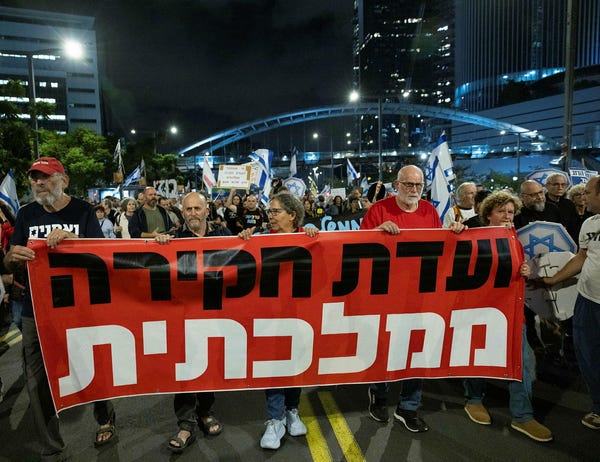 Protest banner calling for a state comission of inquiry in Tel Aviv, November.
In a March 2025 speech to the Knesset, Netanyahu argued that such a commission would be "a commission whose conclusions are already written in advance" and would come entirely from "one end of the political spectrum."
"It is important and vital to investigate in depth everything that happened to us on October 7 and what preceded it, but this investigation has to gain the confidence of the people, or the confidence of an overwhelming majority of the people," the prime minister said. "For that reason, we demand to form an objective, balanced and independent commission of inquiry. Not a commission of inquiry whose conclusions are already written in advance. Do you think that we don't understand this? We want an unbiased, real commission of inquiry."
In December 2025, Netanyahu turned his attention to Supreme Court President Isaac Amit, who under Israeli law is responsible for appointing the members of a state commission of inquiry. He suggested that Amit would assemble a politically motivated panel whose conclusions would lack legitimacy. Netanyahu's allies also floated a proposal that would give politicians control over the appointment of the commission's panel, while expanding the scope of the inquiry to include events dating back to the Oslo Accords.
At the same time, a series of alternative proposals sought to undermine the existing model for a state commission of inquiry. Public figures on the right proposed a commission whose members would be evenly divided between coalition and opposition appointees. President Isaac Herzog suggested that Supreme Court President Amit determine the panel's composition in consultation with his deputy, the conservative Justice Noam Sohlberg. Other proposals were floated calling for a "special state commission of inquiry" whose members would be appointed by Netanyahu and his ministers, the very officials it would be tasked with investigating.
The bottom line is clear: Nearly three years after the greatest disaster in Israel's history, Netanyahu has blocked the only mechanism capable of investigating what went wrong and who was responsible.
Jonathan Lis
Netanyahu ordered Gaza border sealed when Oct. 7 attack began
Benjamin Netanyahu
According to sources and the transcript of his first red phone call, no such order was given
Prime Minister Benjamin Netanyahu claimed in July that, as soon as Hamas launched its October 7 attack, he made sure the Gaza border was sealed to prevent kidnappings. But, according to sources familiar with the events and a published transcript, he issued no such instruction during the first conversations he held that morning.
The sources said the order was not given during his initial WhatsApp call. Nor did he issue it during his first conversation on the secure
"red" line about 10 minutes later, a call whose transcript was later made public.
Speaking on comedian Ben Ben Baruch's podcast earlier this month, Netanyahu said: "In that [first] conversation or the one immediately after, I had only one question: did we close the border with Gaza? I was very concerned they would take hostages."
He repeated the same account in a later interview on another podcast.
"The first thing I [asked army officials and] wanted to know was, 'Did you close the border with Gaza so they wouldn't go back in with hostages?'" he said.
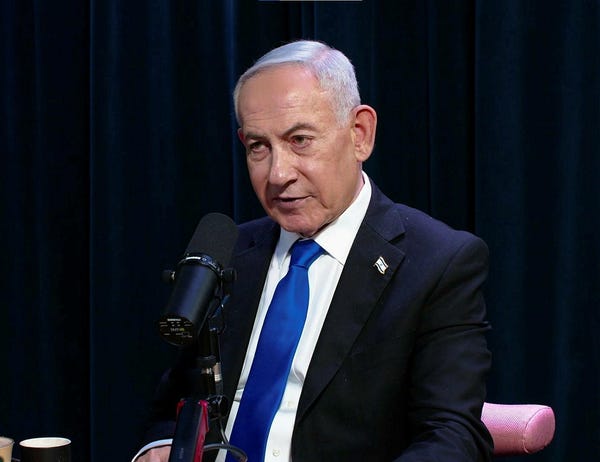 Prime Minister Benjamin Netanyahu during an interview on Ben Ben Baruch's podcast.
According to the sources, Netanyahu received his first briefing via WhatsApp at 6:29 A.M. His military secretary at the time, Maj. Gen. Avi Gil, informed him that Hamas had launched a surprise attack and that rocket sirens were sounding across Israel, but provided no additional details. Gil said he was still gathering information and would brief Netanyahu again over the secure line. The call lasted less than a minute and, because it took place over WhatsApp, no transcript exists.
The second conversation, over the secure "Red Phone," took place at 6:40 A.M. The transcript contains no instruction to seal the border. Sources familiar with the matter added that, at that stage, Netanyahu was still unaware of the scale of the attack and had been caught by surprise, which is why he did not issue such an order.
The conversation opens with Netanyahu trying to assess the scope of the attack.
"What happened? Why did they open fire?" he asks at the outset. Then he asks, "What are they shooting?" and "Is the shooting across the entire country?"
Gil replies that it is a "wide-ranging operation, if not a war in Gaza," updates that there is concern about Hamas members infiltrating Israel and concludes: "We are at war."
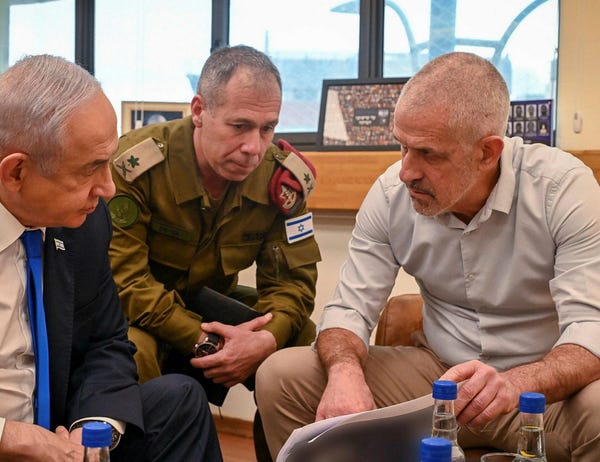 Shin Bet chief Ronen Bar with Prime Minister Benjamin Netanyahu and his military secretary Avi Gil, in 2024.
Later in the conversation, Netanyahu mentions the lack of early intelligence warning. "We have no indication [of a possible attack], I see nothing in the intelligence," he tells Gil, who replies: "We'll need to check later how they surprised us."
Netanyahu then moves on to operational steps. He asks to consider an immediate strike on Hamas leadership, to assess "the scope of the attack," to examine if extensive reserve mobilization is required and to prepare for an IDF General Staff meeting within two or three hours.
It is only at this stage that Netanyahu first raises the possibility that the attack was intended for abductions. "Could this be intended for abductions?" he asks, and Gil replies, "That's what we're thinking."
Even after this exchange, there is no record of a directive to close the border. Instead, Netanyahu orders, "We need to see if we can take down [Hamas'] leadership immediately, [to check] if something is available."
At the end of the call, Gil says that he will hold a round of talks with the heads of the defense agencies and will return to update the prime minister.
Josh Breiner
Top court chief appointed himself to role
Nir Barkat and Avihai Boaron


Isaac Amit was lawfully appointed by the Judicial Selection Committee
On January 27, 2025, the day after Justice Isaac Amit was elected president of the Supreme Court, Economy Minister Nir Barkat appeared on Channel 14 and declared: "Something extraordinary happened yesterday: the judge appointed himself." Likud MK Avihai Boaron made the same claim in an interview with the channel that day, saying, "A Supreme Court justice, deputy to the president, came with his friends, and in practice appointed himself."
In reality, like all his predecessors, Amit was appointed by the Judicial Selection Committee. His appointment complied with Israeli law and followed the seniority system in place since the state's founding, under which the longest-serving Supreme Court justice becomes the court's president.
Since then, the claim has been echoed by a growing list of coalition politicians, following a longstanding delegitimisation campaign conducted by Justice Minister Yariv Levin, architect of the judicial coup, against Amit's appointment, as he is considered an activist judge.
Amit was appointed 15 months after former Supreme Court President Esther Hayut retired. During that time, the court operated without a permanent president for the first time, after Levin, as chair of the Judicial Selection Committee, refused to hold a vote on the appointment.
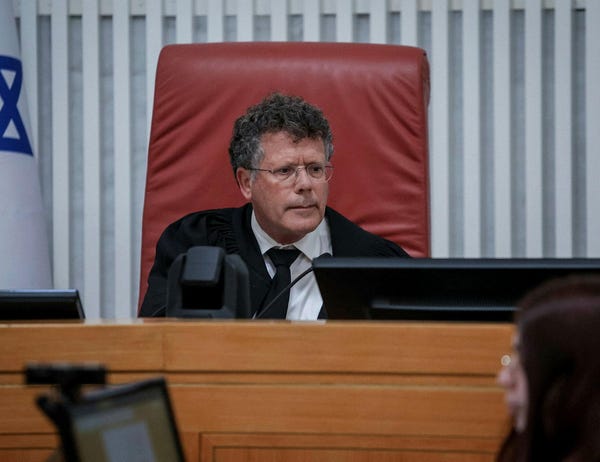 Supreme Court Justice Isaac Amit, in June. He endured a personal smear campaign by right-wing groups.
At the same time, while boycotting Amit's appointment, Levin advanced legislation – set to take effect after the next election – that would overhaul Israel's judicial appointments system, and place the panel under the control of politicians, in what is widely regarded as a blow to democratic due process.
Only after the High Court of Justice ordered the committee to convene did it do so, with Levin boycotting the meeting. In the ruling ordering Levin to convene the committee to appoint a Supreme Court president, Justice Yael Wilner wrote that it was unacceptable for the appointment of the head of the judiciary, "one of the symbols of the State of Israel," to be delayed for more than a year "simply because the minister opposes the [president] selection procedure ratified by the legislature."
Afterward, the justice minister said he did not recognize Amit's appointment as Supreme Court president. "The appointment of the Supreme Court president through the unlawful usurpation of my authority as chair of the committee is fundamentally flawed and illegal," Levin wrote after the vote.
 Supreme Court President Issac Amit, left, and Justice Minister Yariv Levin, last year.
In June, Levin said that "the High Court justices themselves convened the Judicial Selection Committee through an unlawful order and 'appointed' Amit themselves." At the Knesset's opening ceremony in October last year, Knesset Speaker Amir Ohana referred to Amit only as a "Supreme Court justice," rather than as court president, prompting controversy.
Under Israel's Courts Law, the president formally appoints the Supreme Court president following the Judicial Selection Committee's selection. The committee chooses the president under the seniority system that has been in place since the state's founding, under which the longest-serving Supreme Court justice is appointed court president.
In the committee vote held in January 2025, Amit defeated Supreme Court Justice Yosef Elron. He received the support of five members of the Judicial Selection Committee: Supreme Court Justices Daphne Barak-Erez and Noam Sohlberg, Israel Bar Association representatives Muhamad Naamneh and Yonit Kalmanovich and opposition MK Karine Elharrar.
The coalition's representatives – Justice Minister Yariv Levin, Settlements Minister Orit Strock and Otzma Yehudit MK Yitzhak Kroizer – boycotted the vote. But because the appointment required only a simple majority, their absence did not prevent it from going ahead.
Chen Maanit
Settler terror is the work of a handful of teenagers
Benjamin Netanyahu
Defense officials estimate that hundreds of settlers are involved in Jewish terrorism
In an interview with Fox News last December, Prime Minister Benjamin Netanyahu claimed that settler violence is a marginal phenomenon.
"It's much bloated. They're talking about a handful of kids, about 70 kids, not from the West Bank, teens who come from broken homes."
In July, he revised that figure upward, telling CNN it involved "150 or so what you would call juvenile delinquents" who were "brought" into the West Bank. He said they are "not from the settler community, which is law-abiding, outstanding citizens who are massacred by Palestinians."
But according to Israeli security officials, the phenomenon is far broader, involving hundreds of Israelis of various ages.
At the annual review conference of the Israel Police's Judea and Samaria District last February, officials estimated that roughly 300 teenagers and adults living on West Bank hilltop outposts and farms regularly take part in violent incidents. At the same time, they said only about 70 of them were considered "dominant and problematic." The police did not respond to Haaretz's question as to why those identified as the main instigators had not been arrested.
Netanyahu, meanwhile, told CNN that the authorities were taking action against violent settlers. "We have real investigations. We are a transparent country. We can't hide crimes here, whether in the army or the police," he said.
According to the UN Office for the Coordination of Humanitarian Affairs (OCHA), from the beginning of 2023 through May of this year, that same "handful" was responsible for more than 5,300 attacks involving bodily harm or property damage.
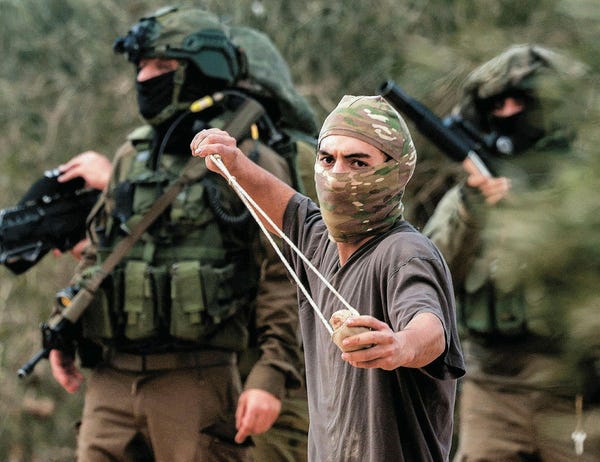 A masked settler hurls stones during the olive harvest in Beita last October.
Government ministries also assess the scope of the phenomenon as far greater than Netanyahu described. Ynet recently reported that, as part of a government program to address the problem, the state would allocate 50 shekels a day for each of 657 youths living on West Bank farms and hilltop outposts. According to the report, the aim is "to provide these youths with support so they don't drift into violence."
Fridays and Saturdays remain the peak days for attacks by Jewish extremists. The perpetrators, undeterred by the Jewish Sabbath, often set fire to Palestinian homes and vehicles. During the week, relatively few youths remain on the hilltops, but on weekends they are joined by friends from nearby settlements or by yeshiva students.
Nor are civilians the only participants. Reserve soldiers and members of local civilian security squads frequently provide security while settlers invade privately owned Palestinian land.
What were once described as "unusual incidents" have become routine: a settler carrying a military-issued rifle standing guard while others torch cars in a Palestinian village; a drunken reserve soldier raiding a village and firing into the air; a reservist protecting a masked accomplice as he steals a horse from a Palestinian village.
Some of these incidents have ended in fatalities. In fact, most Palestinians killed in settler attacks in recent months were shot by settlers carrying military-issued weapons.
Matan Golan
Netanyahu government returned all the hostages
Benjamin Netanyahu and Bezalel Smotrich

Netanyahu obstructed negotiations, while his ministers opposed a hostage deal
In recent months, Netanyahu has repeatedly taken credit for the return of all the hostages. Speaking at a ceremony marking the Knesset's 77th anniversary in February, he declared from the Knesset podium: "Time and again, I stood at this podium and promised we would bring back all the hostages, and that's exactly what we did."
The hostages did return, many of them in coffins after being murdered in captivity. But it is doubtful that Netanyahu deserves the credit. According to Israeli and foreign officials involved in the negotiations throughout the war, the decisive factor behind the eventual agreement was U.S. President Donald Trump. Netanyahu, by contrast, repeatedly obstructed the talks and chose to prolong the fighting rather than reach a hostage deal.
In July, the former head of the Hostages and Missing Persons Command, Nitzan Alon, said explicitly that "the cabinet and political leadership rejected earlier, comprehensive deals in the name of that same absolute victory – which is in fact a falsehood."
He added that the war could have ended at least a year earlier. "We paid a heavy price in soldiers killed, perhaps even some hostages killed, immense costs in blood and money that were not necessary," he said.
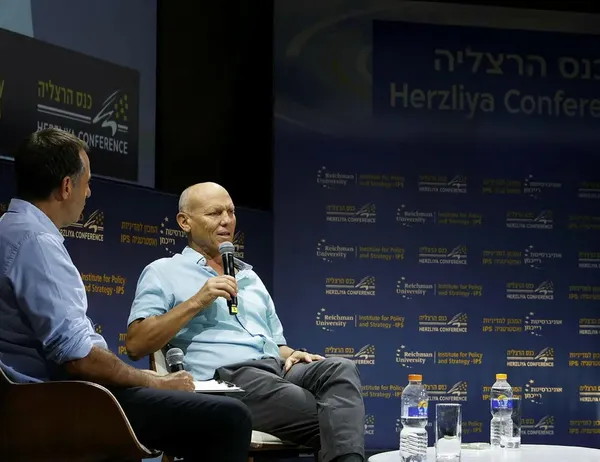 Former head of the IDF's Hostages and Missing Persons Command Maj. Gen. (Res.) Nitzan Alon.
Netanyahu himself said in June 2024 that he was unwilling to end the war in exchange for the release of all the hostages.
"I am prepared to agree to a partial deal that will bring back some of our people. We are committed to resuming the fighting after the pause. That is something I will not compromise on," he said in an interview with Channel 14.
His ministers were equally open about their opposition to hostage deals. National Security Minister Itamar Ben-Gvir boasted in January 2025 that he had blocked several proposed agreements.
The same message was echoed by Netanyahu's spokesman, Omer Dostri, who said in an interview with Channel 12 News in April 2025 that a deal to return all the hostages in a single stage – the very deal that was ultimately signed – was impossible.
"I keep hearing things like, 'One deal, bring them back.' At the moment, there can't be one deal because Hamas isn't saying, 'Come get your hostages and that's that.' It's demanding an end to the war," Dostri said. He dismissed claims that such a deal was possible as "spin," adding that "bringing back everyone will bring back Hamas."
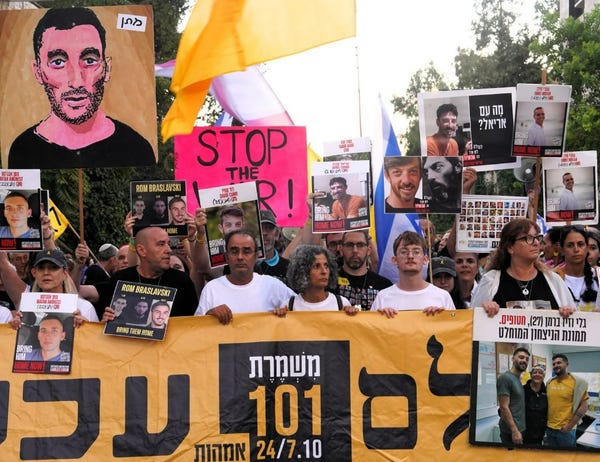 Hostage protest in Jerusalem, September.
In practice, Netanyahu repeatedly narrowed the Israeli negotiating team's mandate, imposed new red lines and prevented meaningful progress in the talks.
"Netanyahu didn't want a deal," a source involved in the negotiations during the Biden administration told Haaretz in October 2025. "He wanted the war to continue and did everything he could to prevent progress in the talks with Hamas."
In an April 2024 interview with the Israeli investigative program Uvda, a senior member of Israel's negotiating team said: "I can't say there would have been a deal without Netanyahu. I can say that the chances of reaching one would have been much higher."
Finance Minister Bezalel Smotrich told a similar lie in June, declaring in a podcast interview: "I think it's thanks to me that all the hostages are here."
In reality, Smotrich argued as early as October 7 that the hostages should not be "a significant consideration." In February 2024, he said in another interview that "the hostages are not the most important thing." Consistent with those statements, he remained one of the most outspoken opponents of the hostage deals that ultimately secured their return.
Jonathan Lis
Only criminals are being killed in Israel's Arab community
Itamar Ben-Gvir

Over a third of Arab murder victims have no ties to organized crime
"I don't make light of any murder, but the people being killed are members of crime families," National Security Minister Itamar Ben-Gvir said in early July when asked about the dramatic surge in homicides since he took office, with the number of killings more than doubling compared with his predecessors' tenure.
From the beginning of 2026 through mid-July, 181 people were murdered in Israel. Of them, 151 were Arab citizens. According to Ben-Gvir, they were all members of organized crime groups.
That is simply not true.
According to several police sources, about 65 percent of the Arab murder victims were known to police as criminals involved in serious offenses. The remaining victims had no ties to organized crime.
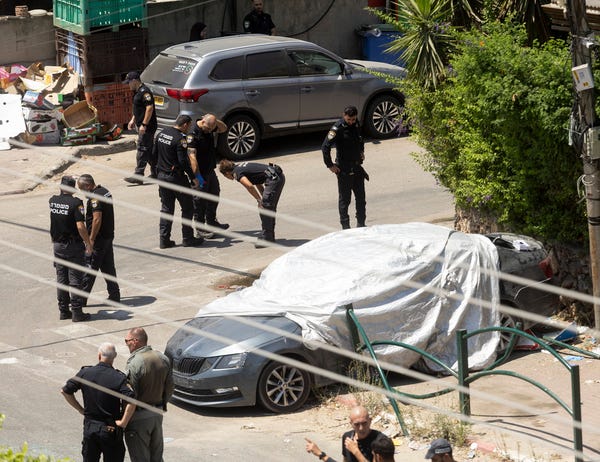 Murder scene in northern Israel, last June.
In some cases, the victims' only "crime" was being related to people targeted by criminal organizations. Others were killed in violent feuds between rival families. None of the 13 Arab women murdered during the period had any connection to criminal activity.
There were also completely innocent victims of organized crime.
That was the case in the double murder in the Druze town of Buq'ata in the northern Golan Heights in June. Marwan Abu Shaheen, a local contractor, had been extorted by criminals and was due to testify against them. His refusal to continue paying protection money cost him his life, along with that of the second victim, Saada Saada, who happened to be standing beside him when the gunfire erupted.
Josh Breiner
Yair Golan knew about Oct. 7 and allowed it to happen
Sara Netanyahu

No evidence was presented; All defense chiefs say there was no betrayal in ranks
Sara Netanyahu insinuated in an interview with pro-government Channel 14 at the end of August that Democrats party chairman Yair Golan had advance information about the October 7 attack. Her statements echoed a conspiracy theory that took shape in the aftermath of the assault: that it was made possible by an act of internal betrayal from within Israel's defense establishment.
According to the theory, defense officials knew in advance about Hamas' plans but concealed the information or deliberately refrained from acting in order to enable the attack. Other versions have alleged that figures associated with the anti-government protest movement – including Golan – were involved in the plot.
However, no one who has promoted the theory has presented evidence to support it. Moreover, Shin Bet chief David Zini, IDF Chief of Staff Eyal Zamir and Sara's husband, Prime Minister Benjamin Netanyahu have all rejected the conspiracy theory and explicitly said there was no betrayal on October 7.
The findings of the IDF's investigations, meanwhile, indicate that the failure to properly understand intelligence received about Hamas' activities was at the heart of the military's failure. In addition, the government has thwarted the establishment of a state commission of inquiry and is preventing an investigation into the circumstances that enabled the attack.
These factors include Netanyahu's decision to facilitate the transfer of funds to Hamas in the years preceding the war, the prime minister's disregard for warnings from senior security officials, as well as UAE President Mohamed bin Zayed, in the months before the massacre that a war could break out, and the judicial overhaul being advanced at the time.
Likud lawmaker Tally Gotliv was among the politicians who most prominently promoted the theory. In January 2024, in posts on X and interviews with the media, she claimed that the husband of protest activist Shikma Bressler, a Shin Bet employee, had spoken with Hamas leader Yahya Sinwar before October 7, and that their conversation had been intercepted and reached the head of the Mossad.
The Mossad denied the claim. Between December 2024 and January 2025, Gotliv five times hinted at a possible connection between Golan and a criminal case in southern Israel in which an IDF officer was accused of impersonating a senior Military Intelligence officer in the weeks following the October 7 attack, gaining access to secret intelligence, which he allegedly documented and shared.
Among other things, Gotliv asked why Golan had not been questioned in the "espionage case," and claimed that he was a dangerous person who evaded scrutiny due to the protection afforded to him as a political figure.
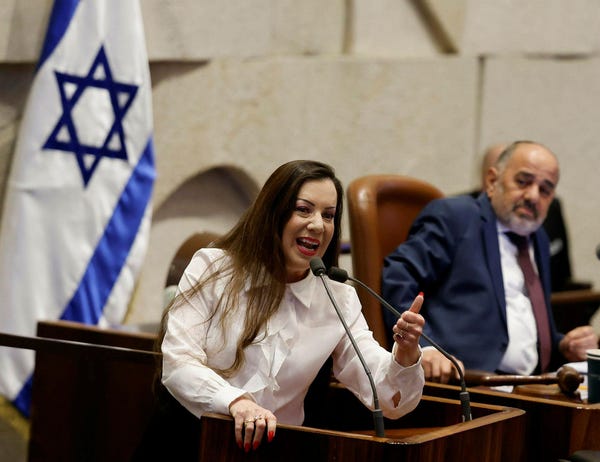 Likud MK Tally Gotliv at the Knesset, in July.
Otzma Yehudit lawmaker Almog Cohen said in an interview with a Ynet podcast in January 2025 that Golan was allegedly connected to an "act of treason" surrounding October 7, and that he had not been questioned because he was "one of the right people." He presented no evidence for the claim. Golan rejected Cohen's allegations and sent him a warning letter ahead of a lawsuit, arguing that the claims were falsehoods amounting to a "blood libel."
Likud lawmaker Nissim Vaturi was asked in a January 2025 interview with the Knesset Channel whether he believed Golan had betrayed Israel on October 7. He initially replied, "Given his statements, I wouldn't be surprised by anything." When the interviewer asked him explicitly, "Including betrayal?" Vaturi answered: "Yes."
Vaturi was also asked about the fact that Golan had traveled to southern Israel and helped civilians on the day of the attack. "I don't know if he saved people," he replied. The remarks prompted a furious response from Golan, who subsequently filed a defamation suit against Vaturi.
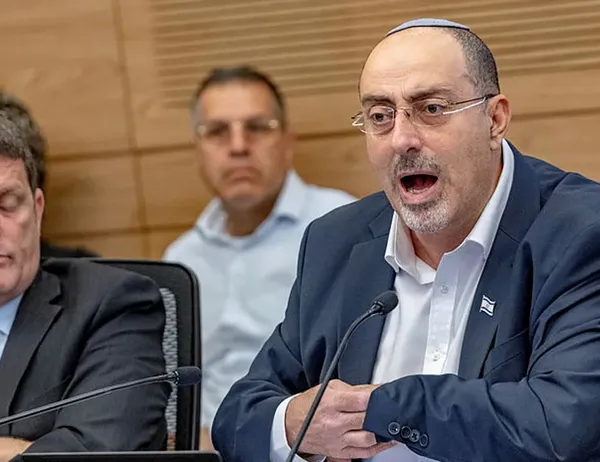 Likud MK Nissim Vaturi, last month.
Otzma Yehudit lawmaker Zvika Fogel has also raised the possibility that something more than a professional failure lay behind the October 7 disaster. In a January 2024 interview with Radio North, he said: "Something stinks. Someone knew what was happening in the Gaza Strip."
The most recent insinuation came from the prime minister's wife, who in the same interview with Channel 14 suggested that Golan knew about the October 7 attack before the prime minister did. "You claim you're a fighter on October 7. You were already there early in the morning, dressed and ready. At a very early hour, when others didn't know, such as the prime minister," Sarah Netanyahu said. When asked directly about the theory of "internal betrayal," she did not explicitly endorse it, but neither did she reject it. Her remarks sparked an uproar, and Golan announced that he intended to sue her.
The claim is based on the fact that Golan traveled south in the early morning hours. According to his account, however, he left his home at around 8:30 A.M. – roughly an hour and a half after the attack began – after learning from radio broadcasts that Hamas had invaded Israel. At around 10 A.M., he arrived at the Home Front Command headquarters in Ramle, where, following a situation assessment in the command's war room, he signed for equipment and was issued a weapon.
From there, Golan continued south toward the IDF's Urim base. After helping search the base, where an attack had been repelled, he spoke by phone with his sister. She told him that a friend had informed her that participants in the Nova music festival were hiding in the fields near the festival site. Golan drove to the area, where he met Oz Davidian, who was busy evacuating festivalgoers in a pickup truck. Golan joined Davidian's vehicle and spent hours helping evacuate survivors of the festival, among them the son of Haaretz reporter Nir Gontarz, who had called Golan and asked for his help.
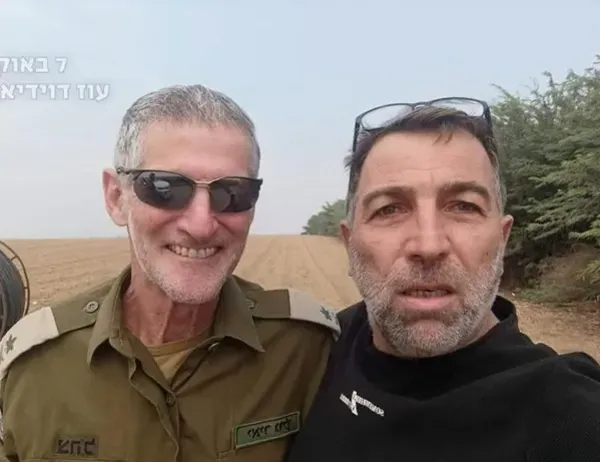 Oz Davidian and Yair Golan, on October 7, 2023.
According to the IDF's investigations, the military had identified Hamas' capabilities and preparations for years and was also familiar with the organization's "Jericho Wall" plan – its operational blueprint for an attack on Israel. Yet both defense and political officials struggled to believe that Hamas intended and was capable of carrying it out, remaining wedded to the assessment that the organization was deterred and interested in an accommodation.
The IDF has also determined that it possessed "high-quality and unusual intelligence" before the attack, and that during the night of October 7, information accumulated that, had it been properly analyzed, could and should have prompted a warning of a large-scale attack. A report examining the IDF's investigations identified six central factors behind the failure: a conceptual failure, an intelligence failure, insufficient attention to the Jericho Wall plan, a flawed organizational and operational culture, a gap between the threat and the military response, and failures in decision-making and the deployment of forces on the night of the attack.
Chen Maanit
Iran already had nuclear bombs before Israel attacked
Benjamin Netanyahu
Security sources and IAEA reports say there is no basis for the claim
In an interview on pro-government Channel 14 at the end of June, Prime Minister Benjamin Netanyahu said he had "decided to strike Iran twice in order to save us from annihilation by nuclear bombs that they already had. Who knows who would still be here today?"
A senior Israeli source familiar with Iran's nuclear program told Haaretz that Netanyahu's claim that Iran possessed nuclear bombs was "a complete lie."
Until that interview, Netanyahu had been careful not to claim that Iran had already crossed the nuclear threshold before the June 2025 war with Iran.
For example, at a June 15 press conference, he said: "Had we not acted when we did, Iran would already have nuclear bombs." He said that such a scenario would have exposed "millions of Israelis" to the "terrible danger of mass death."
He made similar remarks at an IDF officers' graduation ceremony, at a conference for local government and at the annual memorial ceremony for his brother Yoni Netanyahu, consistently saying Iran would have obtained nuclear bombs had Israel not acted.
The security source's denial that Iran possessed nuclear weapons is also supported by the International Atomic Energy Agency. Public IAEA reports contain no indication that Iran had nuclear weapons.
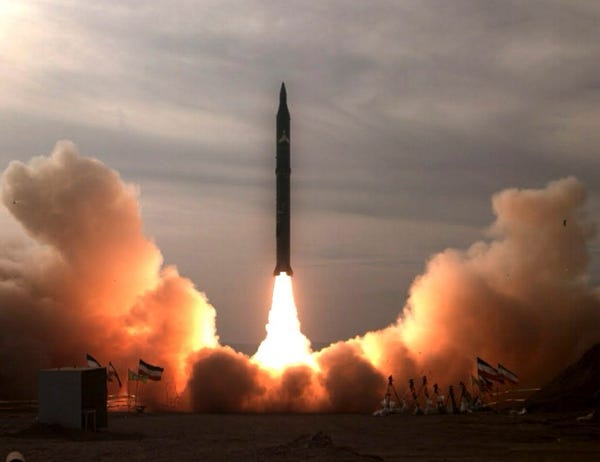 Iranian missile launch. 'Netanyahu is inventing a reality, inventing a threat,' said Eisenkot. 'And that's how he frightens the Israeli public.'
In June, IAEA Director General Rafael Mariano Grossi told the agency's Board of Governors that, before the June 2025 military operation, inspectors had verified that Iran possessed 440 kilograms of highly enriched uranium – not a completed nuclear weapon.
Since June 2025, the IAEA has no longer been able to monitor Iran's nuclear material because Tehran has refused to cooperate. Even so, none of Grossi's public statements over the past year have suggested that Iran possesses operational nuclear weapons.
Opposition politicians also criticized the statement. Former IDF Chief of Staff and Yashar party leader Gadi Eisenkot said Netanyahu "made an absurd statement… Iran had no nuclear bombs. I know the intelligence picture. He's inventing a reality, inventing a threat, and that's how he frightens the Israeli public." Former Prime Minister and Together party leader Naftali Bennett was equally blunt: "That's simply not true."
Jonathan Lis
Attorney general involved in Sde Teiman abuse video leak
Itamar Ben-Gvir and Tally Gotliv

Police cleared Gali Baharav-Miara of any involvement
In October 2025, police launched a criminal investigation into the leak of a video showing the alleged abuse of a Gazan detainee at the Sde Teiman military detention facility in 2024. The footage led to the arrest of five soldiers from Force 100, the unit responsible for guarding detainees at the facility, before the charges against them were dropped earlier this year.
Military Advocate General Itay Offir cited several reasons for his decision not to pursue the indictments, claiming abuse of process due to "the conduct of senior officials in the Military Advocate General's Corps and the IDF's law enforcement system in this case, and its exceptional and unprecedented circumstances."
 Former Military Advocate General Yifat Tomer-Yerushalmi leaving prison, in November.
The police investigation found that then-Military Advocate General Yifat Tomer-Yerushalmi and other senior officials in the Military Advocate General's Corps had unlawfully leaked the footage to Channel 12 News.
Investigators also examined a more serious allegation: that Tomer-Yerushalmi and those officials had attempted to cover up the leak by creating a fictitious investigative team and submitting a statement in its name to the State Prosecutor's Office and the Supreme Court, falsely claiming that it had been unable to identify the source of the leak.
Because the State Prosecutor's Office was involved in the review, it was decided that Attorney General Gali Baharav-Miara would not be handling the case. Against that backdrop, right-wing figures falsely claimed that Baharav-Miara had been complicit with Tomer-Yerushalmi in the alleged criminal acts. In February, police announced that Baharav-Miara was not involved in the affair.
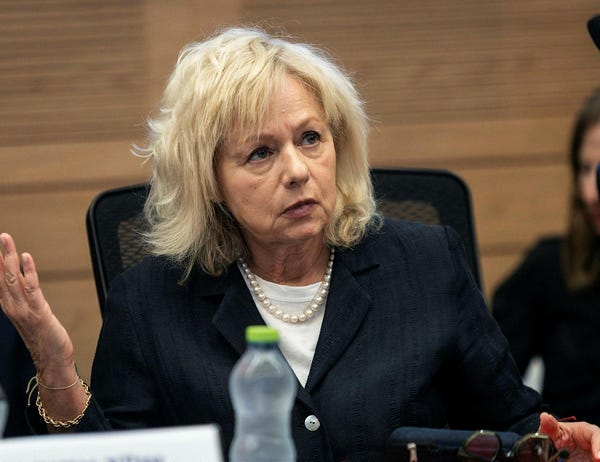 Attorney General Gali Baharav-Miara.
The first to make the accusation was National Security Minister Itamar Ben-Gvir, who claimed that evidence on the military advocate general's cellphone would incriminate Baharav-Miara and prove that she "knew who leaked" the video. He added that he knew this "for certain."
Religious Zionism MK Simcha Rothman echoed the allegations, accusing the attorney general of obstructing the investigation and helping cover up the leak. He also claimed that her office had submitted false affidavits to the Supreme Court and argued that she, too, should be investigated.
Likud MK Tally Gotliv accused Baharav-Miara of deliberately preventing an investigation and deceiving the court, alleging that her representatives had knowingly misled the Supreme Court.
In November 2025, about three weeks after the military advocate general was arrested, senior police officials told Haaretz that, contrary to Ben-Gvir's claims, investigators had found no evidence linking Baharav-Miara to the leak.
In December, it was reported that the investigation had been completed, although publication of its findings was delayed for another two months. Finally, in February, likely much to Ben-Gvir's disappointment, police announced that Baharav-Miara had not been involved in the affair and had no knowledge of the actions of senior Military Advocate General's Corps officials.
Chen Maanit
IDF, Shin Bet prevented Netanyahu from killing Hamas leaders
Benjamin Netanyahu
Netanyahu repeatedly chose not to move forward with assassinations
In recent months, Prime Minister Benjamin Netanyahu has claimed that he repeatedly sought to authorize the assassination of senior Hamas leaders but was blocked by the IDF and the Shin Bet security service.
In a document he published in February, which he said contained his responses to questions submitted by State Comptroller Matanyahu Englman as part of an ongoing review, Netanyahu wrote that "the prime minister has always supported targeted killings as an effective deterrent tool." But when it comes to the planned assassinations of Mohammed Deif and Yahya Sinwar, the prime minister's account appears to be the exact opposite of what actually happened.
In 2022, while Netanyahu was in the opposition, the IDF and the Shin Bet began planning a covert operation. The plan called for Hamas leaders Yahya Sinwar and Mohammed Deif, codenamed "Ace" and "King," respectively, to be assassinated simultaneously.
The operation was presented to then-Prime Minister Naftali Bennett, who met with senior security officials in early May that year and asked that it be carried out immediately. At that point, however, the plan was not yet operationally ready, and the Bennett-Lapid government fell the following month.
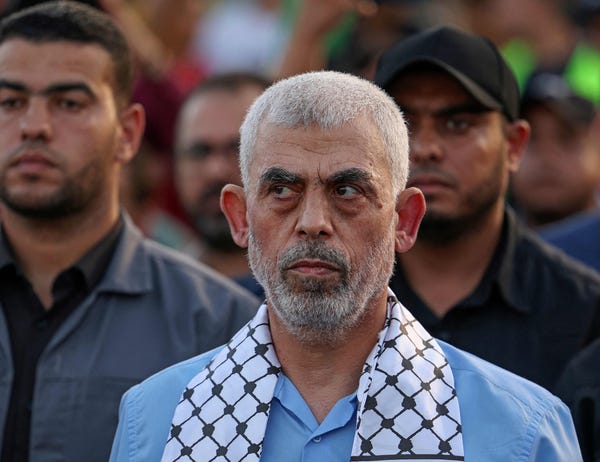 Yahya Sinwar in Gaza, 2022.
After Netanyahu returned to office, the plan was presented to him as well. According to senior officials who spoke to Haaretz, he rejected it 11 times before October 7.
The Shin Bet was the driving force behind the operation and worked to gather the intelligence needed to carry it out.
"Netanyahu likes quiet operations, assassinations that don't require taking responsibility," a senior security source told Haaretz. For that reason, throughout his time in office, Netanyahu also declined to authorize several other military operations, including airstrikes, that were far less extensive than the proposed assassinations.
According to the source, those operations would have clearly borne Israel's fingerprints, whereas Netanyahu insisted on exploring more covert alternatives. When none existed, he preferred not to act.
Michael Hauser Tov
Netanyahu-approved Qatari money to Hamas did not enable Oct. 7
Benjamin Netanyahu
Qatari funding to Hamas was diverted to its military wing, a key factor that lead to the October 7 massacre
Since the October 7 attack, Prime Minister Benjamin Netanyahu has repeatedly claimed that the Qatari money transferred to Gaza under his policy was used solely to support civilians and never reached Hamas' military wing or financed the construction of its tunnel network.
According to Netanyahu, Hamas relied instead on other sources of funding, including European Union aid and direct financial support from Iran. He has also sought to distance himself from responsibility for the Qatari payments, blaming Israel's security establishment even though he was the architect and chief advocate of the policy.
"The money transferred to Hamas was transferred on the recommendation of the Shin Bet and the Mossad," Netanyahu said at a press conference in May last year. "It was a tiny fraction of all the money Hamas received from Iran, international organizations, the European Union and other sources."
The Qatari money, he said, went to 100,000 "people in need" and "sewage and electricity."
Netanyahu also dismissed criticism of his decision to allow hundreds of millions of dollars in Qatari cash into Gaza and denied any connection between those transfers and the October 7 attack.
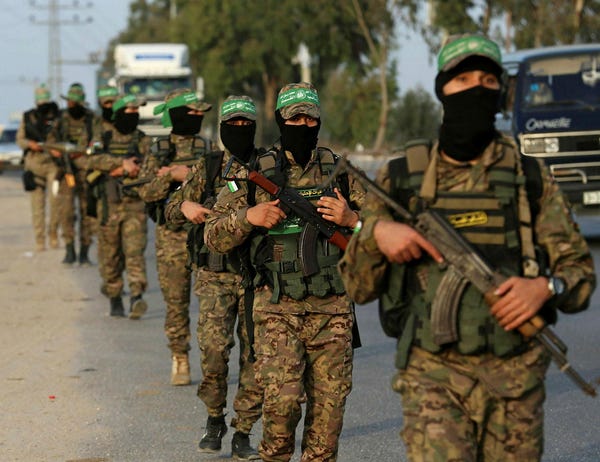 Hamas gunmen.
"You're trying to suggest that this money paid for October 7," Netanyahu said. He argued that Hamas attacked Israel using "flip-flops, Kalashnikovs and pickup trucks" that "cost next to nothing" and that the Qatari funds were only "a small part" of Hamas' overall financing.
Netanyahu's claims are contradicted by years of Shin Bet warnings that Hamas was diverting Qatari funds to its military wing. In a confidential letter sent to Netanyahu in 2019 and later revealed by Kan 11, then-Shin Bet chief Nadav Argaman warned that the agency had identified funds flowing from Qatar to Gaza that "have been diverted to Hamas' military wing."
Netanyahu himself acknowledged in a 2019 interview with TIME that Hamas "take[s] all the money that comes in from international support – and there's quite a bit of it – and they put it into turning tunnels into a terror machine."
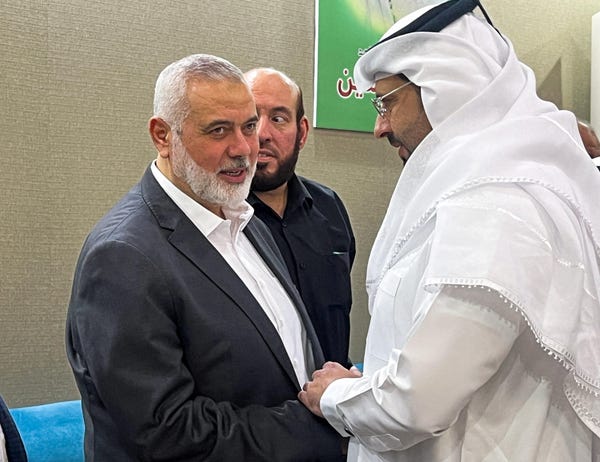 Hamas leader Ismail Haniyeh in Qatar.
The Shin Bet's internal investigation into the October 7 attack explicitly concluded that Qatari funding was one of the central factors that enabled Hamas to launch the assault.
Moreover, documents seized by the IDF in Gaza showed that Qatar had secretly financed units of Hamas' military wing under the guise of charitable donations and through grants to the organization's leadership in Qatar. According to a report by Haaretz from 2019, Qatar transferred more than $1.1 billion to Gaza between 2012 and 2018 to fund infrastructure, fuel, salaries and welfare programs.
"It is reasonable to assume that this money allowed Hamas to divert hundreds of millions of dollars to terrorism that otherwise would have had to be spent on civilian welfare," a source in Israel's security establishment told Haaretz.
Jonathan Lis
Arab MKs care only about the Palestinian issue
Itamar Ben-Gvir and May Golan

Almost all bills by Arab lawmakers' involved social issues affecting all Israelis
For more than a decade, politicians on the right have repeatedly claimed that Arab members of Knesset neglect the needs of their constituents and focus almost exclusively on the Palestinian issue.
In an interview with Channel 14 about five months ago, for example, Social Equality Minister May Golan claimed that "they don't care about the murders" of Arab citizens of Israel, "only about the inciting nationality and preaching against the State of Israel."
In February 2025, National Security Minister Itamar Ben-Gvir told Arab lawmakers in the Knesset: "You don't care about an 8-year-old girl from Rahat who was murdered. You don't care about a 10-year-old boy who was murdered. You come to the Knesset only to talk about Palestine."
The claim predates both Ben-Gvir and Golan. Variations of it have been made over the years by Avigdor Lieberman, David Amsalem, Gilad Erdan, Moshe Ya'alon and others. In 2020, it also featured in Likud's Arabic-language election campaign, which showed members of the Joint List relaxing over coffee and claimed they had done nothing for their voters.
However, the parliamentary record tells a very different story. A 2021 study by the nonprofit Abraham Initiatives found that 91 percent of the bills and 97 percent of parliamentary motions submitted by Arab lawmakers during two Knesset sessions dealt with social issues. Just 5 percent of their parliamentary activity focused on Palestinian issues, fully contradicting the right-wing lawmakers' arguments.
Among the issues Arab lawmakers promoted were combating violent crime in Arab society, increasing employment among Arab women, relocating hazardous power lines in Arab communities, expanding fiber-optic infrastructure and introducing public transportation on Saturdays in Arab localities. They also advanced broader issues, including compensation for self-employed workers, assistance for young couples and improvements to Israel's healthcare system.
Among other initiatives, Yousef Jabareen (now chairman of Hadash-Ta'al) scrutinized the Education Ministry's failures in distributing computers for remote learning during the COVID-19 pandemic; Ahmad Tibi secured an additional 5 million shekels for lower-division sports leagues through the national sports budget; Aida Touma-Sliman promoted a wage agreement for medical personnel required to quarantine during the pandemic and sponsored legislation requiring courts to refer abusive men subject to protection orders to treatment programs.
Other legislative proposals included Heba Yazbak's bill granting double child allowances to parents of twins or higher-order multiples, Ahmad Tibi's proposal allowing prescriptions to be filled at any pharmacy, and Ayman Odeh's bill capping the pay ratio in publicly traded companies at 20-to-1 between the highest- and lowest-paid employees in an effort to reduce income inequality.
Jack Khoury
Bennett-Lapid government gave billions to Arab party UAL
Benjamin Netanyahu
The Bennett-Lapid government approved funding to improve Arab Israelis' conditions
In recent years, Prime Minister Benjamin Netanyahu has repeatedly claimed that the Bennett-Lapid government gave 53 billion shekels to what he described as "Mansour Abbas' Muslim Brotherhood party," meaning the United Arab List.
Abbas' party – which has recently broken away from the Islamic Movement – has made it clear that despite their ideology and belief in Islamic Sharia, they do not belong organizationally to the global Muslim Brotherhood movement and are not part of its international institutions.
"You didn't call those enormous political payouts 'coalition funds,' 'plunder' or 'looting the public purse,' because you were on the right side, the enlightened side," Netanyahu said at the start of the cabinet meeting in May 2023. "What hypocrisy. What arrogance. What a lie."
In reality, contrary to the impression Netanyahu sought to create – that the Bennett-Lapid government handed the UAL a blank check in exchange for joining the coalition – the funding was earmarked for specific programs aimed at promoting economic growth in Arab society, increasing productivity, improving education and employment, and upgrading public services in Arab communities.
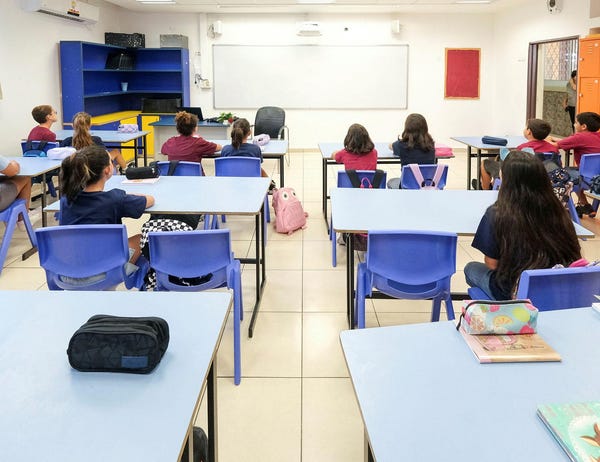 An Arab-majority school in Israel.
In 2021, the Bennett-Lapid government approved three long-term programs. The first was a five-year plan to reduce socioeconomic gaps in the Arab, Druze, Circassian and Bedouin communities, with a budget of 30 billion shekels.
Another allocated 20 billion shekels to improve transportation infrastructure in Arab communities, building on a plan introduced a year earlier by then-Transportation Minister Miri Regev. A third provided funding to combat crime and violence in Arab society.
In February 2023, Netanyahu's government reaffirmed the five-year plan. But in the revised 2024 budget, it cut the program by 15 percent – three times the rate imposed on other government ministries. In January last year, Regev effectively scrapped the transportation infrastructure plan.
Jonathan Lis
Top court limited IDF’s open-fire rules
Yariv Levin

The justices upheld the existing regulations, ruling that they were lawful
In a November 2023 interview with Channel 14, Justice Minister Yariv Levin argued that the judiciary's approach had "tied our hands," adding that "it's unthinkable that soldiers should be afraid to shoot" at Palestinians approaching the Gaza border fence.
In doing so, Levin echoed a claim that quickly spread on social media: that the Supreme Court had changed the IDF's rules of engagement along the Gaza border, helping create the conditions that enabled the October 7 attack.
The lie spread so widely that Israel's judiciary took the unusual step of issuing a public clarification, emphasizing that the Supreme Court had never intervened in the military's open-fire regulations along the Gaza border.
In fact, the opposite is true.
In 2018, the High Court of Justice heard petitions challenging the IDF's implementation of its open-fire regulations during Palestinian protests along the Gaza border, in which dozens of Palestinians were killed. It rejected all of them.
The justices wrote that judicial intervention in such matters must be extremely limited. They added that they accepted the state's assurance that live fire is used only as a last resort and in self-defense.
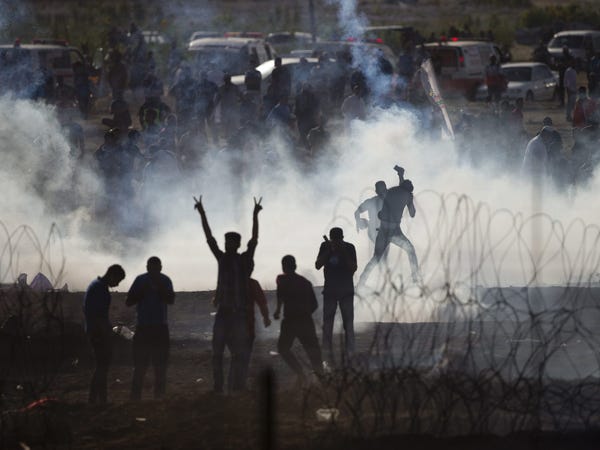 Protests in Gaza, June 2018
"Among the rioters were some who threw rocks and firebombs at Israeli troops. Therefore, it seems that gunfire was employed to achieve a legal purpose – defending citizens of the state and Israeli soldiers," Melcer wrote.
Then-Supreme Court President Esther Hayut added that the complexity of the situation stemmed largely from the "mixture of terrorists and the civilian population."
That did not stop right-wing politicians from continuing to repeat the lie.
In November 2024, MK Tally Gotliv (Likud) repeated it in the context of fighting in Lebanon, telling i24NEWS that the High Court "interfered with the rules of engagement for anyone approaching the fence. That's how you end up with Hezbollahlings reaching the fence and nobody shoots them."
Shortly afterward, Galit Distel Atbaryan repeated the same falsehood while arguing against establishing a state commission of inquiry into the October 7 attack. According to her, "the Supreme Court is the last body" that should investigate the failures because, in 2018, it had "accepted a petition" against the IDF's open-fire regulations along the Gaza border – or, as she put it, against the army's response to "the October 7 Nukhba terrorists."
Chen Maanit
Education minister ensured students can put on tefillin at school
Yoav Kisch

Students have never been prohibited from putting on tefillin at public schools
Education Minister Yoav Kisch announced in July that he had formally regulated the issue of tefillin, or phylacteries, in Israel's public schools through a new Education Ministry directive.
The directive instructs school principals to allow students to put on tefillin on school grounds and to establish procedures governing how the policy should be implemented. But contrary to Kisch's claims, students had never been prohibited from putting on tefillin, and tefillin stands have been stationed at schools even prior to the directive.
Kisch appears to be exploiting schools and administrators for political gain, while using students to further his agenda – much like lawmakers from National Security Minister Itamar Ben-Gvir's far-right Otzma Yehudit party.
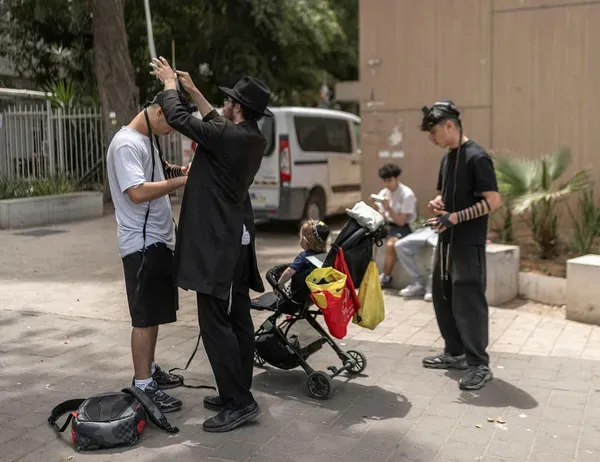 Teenage boys praying with tefillin outside a Tel Aviv school, April.
In early January 2024, Zeev Degani, principal of Gymnasia Herzliya in Tel Aviv, had a run-in with a Chabad activist who was trying to persuade boys to put on tefillin outside the school's entrance. The following day, Otzma Yehudit MK Almog Cohen attended a mass protest organized outside the school.
In another case, an ultra-Orthodox activist approached teenagers in Hod Hasharon and encouraged them to set up a tefillin stand outside a middle school.
In February last year, a student at Ohel Shem High School in Ramat Gan set up a tefillin stand inside the school without permission, despite the fact that one already existed. The student was summoned to a disciplinary hearing, but the incident quickly spread on social media and was portrayed as a "religious war" after Ben-Gvir described the student as an "Otzma Yehudit coordinator."
Shortly afterward, the party organized a protest outside the school during which right-wing activist Mordechai David forced his way into the principal's office.
Noa Limone
Israel ‘one step away’ from total victory in Gaza
Benjamin Netanyahu
Almost three years after October 7, Hamas still controls Gaza
Since the October 7 disaster and throughout two years of war, Prime Minister Benjamin Netanyahu has repeatedly declared that Israel was on the verge of achieving "total victory" over Hamas. He has insisted not only that such a victory was attainable, but that Israeli forces were just weeks away from completing the mission. Time and again, reality has proved otherwise.
Two months into the war, at a Hanukkah candle-lighting ceremony held at the Western Wall on December 7, 2023, Netanyahu declared: "We will soon achieve total victory over the forces of evil and restore security not only to the south but also to the north."
Three months later, at the start of a cabinet meeting in April 2024, he declared: "We are about one step away" from victory in Gaza.
In August 2025, Netanyahu and his security cabinet set five objectives that had to be achieved before the war could end: disarming Hamas, securing the return of all the hostages, the complete demilitarization of Gaza, permanent Israeli security control including the perimeter zone, and the establishment of an alternative civilian administration that would be neither Hamas nor the Palestinian Authority.
A cease-fire agreement was signed last October, but as of August 2026, Hamas has not been defeated. The group has yet to disarm, and Israel continues to control a significant portion of the Gaza Strip – beyond the Yellow Line set out to separate the sides in the agreement – while striking Hamas targets and operatives almost daily, with dozens of Palestinians killed every month. The IDF also assesses that Hamas has used the recent period to rebuild its capabilities.
In January 2026, the Board of Peace was established by U.S. President Donald Trump, an international body led by the United States that is intended to administer the Strip through a Palestinian technocratic committee. In late July 2026, the Board of Peace and Hamas agreed on a framework for disarming the group, which is meant to lead to an Israeli withdrawal and the transfer of Gaza's administration to the Palestinian technocrats. However, the date on which the committee will begin operating has yet to be set, and Hamas remains the de facto authority in areas west of the Yellow Line.
Under the current agreements, the IDF is authorized to control 53 percent of the Strip. In practice, Israel currently controls an estimated 60 to 70 percent of the territory, without international approval.
Jonathan Lis
Comments